
Home / Learn / AI Chips / What Is an NPU?
On this page
What does an NPU do?How does an NPU work?NPU vs CPU vs GPUWhere are NPUs used?What are the limits of an NPU?NPU arrays in data center AI chipsNPU: common questionsWhat Is an NPU? Neural Processing Units Explained
An NPU (neural processing unit) is a processor built to run AI models, and to do it using far less power than a CPU or GPU would. It does one kind of work, the arithmetic inside neural networks, and it’s designed around that work from the ground up.
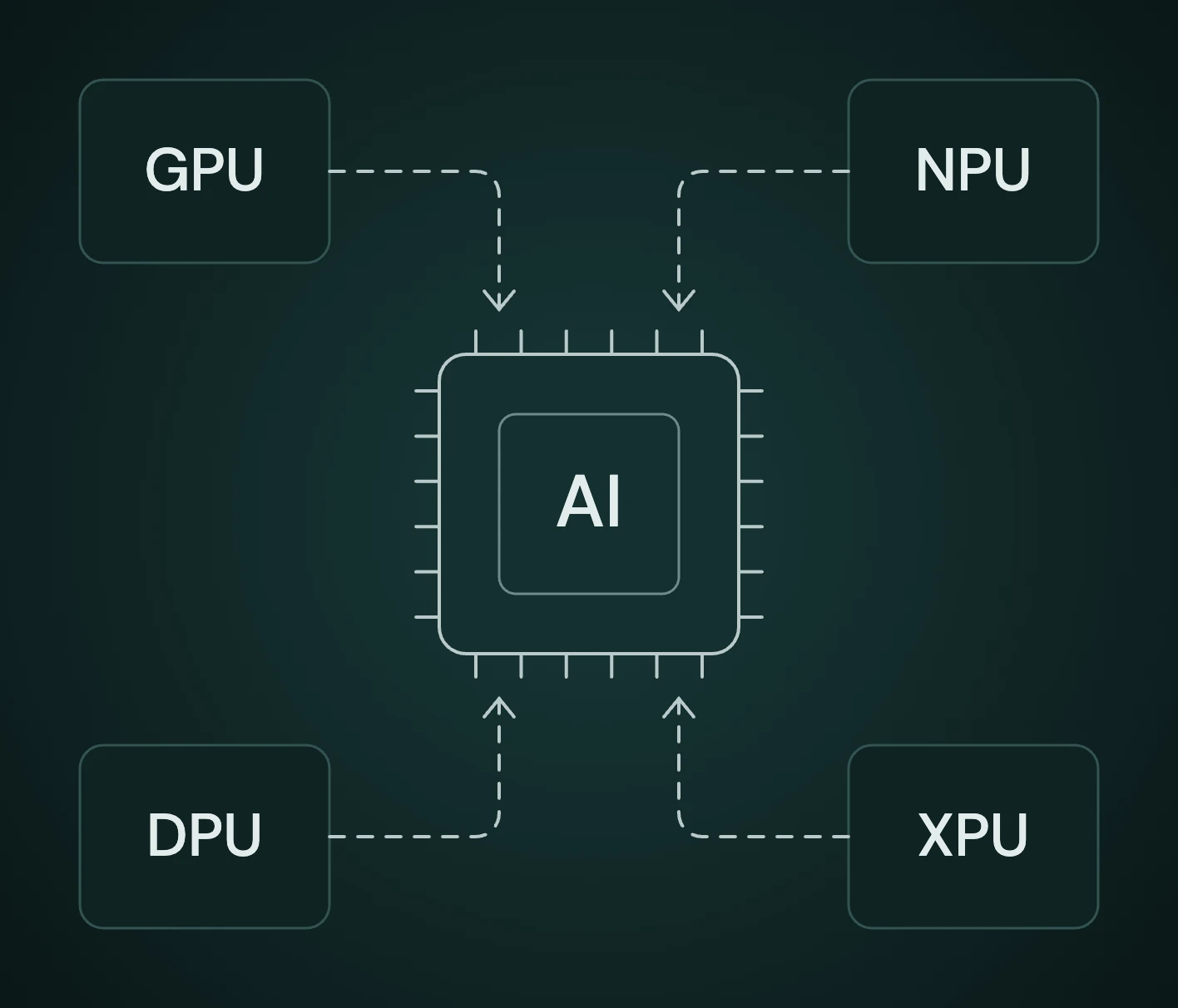
You’ve probably seen NPUs advertised in phones and laptops. They also sit inside data center chips, where they’re arranged in large arrays. This guide explains what an NPU does, how it works and where its limits are.
What does an NPU do?
An NPU runs trained AI models. That task is called inference: you give the model an input, such as a photo or a sentence, and it produces an output.
Inference is mostly one operation repeated an enormous number of times: multiply two numbers, add the result to a total, move on. A CPU can do this, but slowly. A GPU can do it quickly, but it’s built to handle many other kinds of work too, and that generality costs power. An NPU strips away everything that isn’t needed for this one job.
How does an NPU work?
Think of the difference between a workshop and an assembly line. A workshop can build anything, one piece at a time. An assembly line builds one thing, and builds it far faster and cheaper. An NPU is the assembly line.
Three design choices make that possible:
- Rows of identical arithmetic units that all work at the same time.
- Simpler numbers. Many NPUs use 8-bit whole numbers where a GPU would use larger decimal formats. Smaller numbers need smaller circuits and less memory.
- Memory placed right next to the arithmetic, so data doesn’t travel far.
The result is a chip that does a lot of AI work for very little electricity.
NPU vs CPU vs GPU
| CPU | GPU | NPU | |
|---|---|---|---|
| Built for | Any software | Any parallel math | Neural networks only |
| Flexibility | Highest | High | Lowest |
| Power use for AI inference | Highest | Medium | Lowest |
| Can train AI models | Slowly | Yes | Rarely |
A GPU and an NPU are closer cousins than either is to a CPU. The trade between them is flexibility against efficiency. If your models keep changing, a GPU copes better. If you run the same models all day and care about your power bill, an NPU wins.
Where are NPUs used?
- Phones and laptops, for features like voice recognition and photo processing that run on the device.
- Cameras, cars and industrial equipment, where power and heat are tightly limited.
- Data center chips, where many NPU cores are combined to run AI for thousands of users at once.
What are the limits of an NPU?
The assembly line comparison cuts both ways. An NPU is superb at what it was built for and awkward at anything else.
Each NPU supports a set list of AI operations. If your model uses one that isn’t on the list, that part of the model has to run on slower hardware, and much of the benefit disappears. AI models also change faster than chips do, so an NPU designed too narrowly around today’s models can age quickly.
Software matters just as much as the hardware. Every NPU relies on a tool called a compiler to translate a model into instructions the chip understands. A good NPU with a poor compiler will underperform.
Memory is the other common limit. A model has to fit in the memory the NPU can reach, and moving data in and out takes time and power. A chip can have plenty of arithmetic capacity and still be held back if it can’t be fed data quickly enough. That is why headline figures rarely tell the whole story.
NPU arrays in data center AI chips
A single NPU core isn’t powerful enough for data center work, so chip designers combine many of them. Kalray’s NPU Array is one example of how that’s done. It’s built from tiles: compute tiles for the arithmetic, memory tiles and networking tiles. Each compute tile delivers 13 TFLOPS, and each networking tile carries 1.6 terabits per second. A chip designer arranges as many tiles as the job needs.
Notice that the networking is part of the design from the start. However fast the arithmetic is, the chip can only work on data that has arrived.
NPU: common questions
What does NPU stand for?
Neural processing unit.
Is an NPU better than a GPU?
For running stable AI models efficiently, usually yes. For training models, or for models that change often, a GPU is the better choice.
Is an NPU the same as an AI accelerator?
An NPU is one type of AI accelerator. The wider term also covers GPUs used for AI and other custom AI chips.
How is NPU performance measured?
Usually in TOPS, trillions of operations per second, and TOPS per watt. See our guide to TOPS per watt for how to read those figures.
NPU technology for custom AI chips
Kalray licenses its NPU Array along with the networking, data movement and processor designs from its DPU chips, so teams building their own AI processors don’t have to design every part themselves.